
Airport Check-In Counter Set Dressing: Choosing Ticket Counters for Film
October 18, 2026
Baggage Claim and Arrivals Set Dressing: Luggage Carts, Signage and Props
October 20, 2026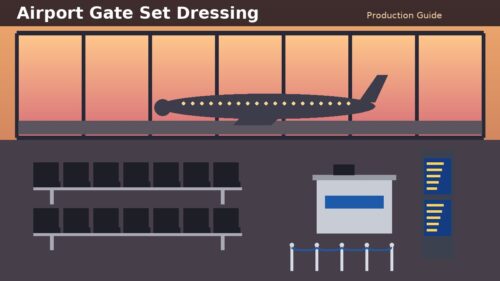
The departure gate is where airport stories slow down. Characters wait, argue, fall asleep, miss boarding calls and meet strangers, so the gate area often carries more screen time than the check-in hall or the checkpoint. This guide is for production designers, set decorators, prop masters and producers planning airport gate set dressing for film, TV, commercials and music videos. It covers the four zones of a believable gate, the terminal seating configurations you can rent from our airport terminal seating collection in Los Angeles, and the small details that make a waiting area read as real on camera.
The four zones of a gate area
Most real gates follow the same pattern, and copying it is the fastest way to a set that audiences accept without thinking:
- The gate podium. Where agents work, scan boarding passes and make announcements.
- The boarding lane. A short queue marked with stanchions and boarding group signs, leading to the jet bridge door.
- The seating area. Rows of connected seats facing the windows or the podium, broken up by tables and charging points.
- Information and wayfinding. Flight information displays, gate signs and overhead directional signage.
Decide early which zones the camera will actually see. A dialogue scene in the seating area may only need two seating banks and a monitor in the background, while a boarding sequence needs the podium, the lane and the door in one frame.
Choosing terminal seating
Seating fills the most floor space and the most frame, so it is worth planning bank by bank. Our Herman Miller terminal seating is 34 in high and 27 in deep in every configuration, which keeps rows consistent when you mix lengths.
Long banks for wide shots
The 7-bank (164 in wide, 11 available) and the 4-bank (96 in wide, 11 available) are the workhorses for filling a departure lounge quickly. The 5-bank (118 in wide, 4 available) and the 5-bank with double table (156.5 in wide, 1 available) add variety to long rows.
Banks with tables for dialogue
Tables give actors somewhere to put coffee, phones and boarding passes, which makes blocking easier. Choose the 3-bank with table (91 in wide, 6 available), the 2-bank with table (69 in wide, 1 available), or the center-table versions: the 2-bank with center table (5 available) and the 3-bank with center table (6 available).
Short banks for row ends and tight sets
The plain 3-bank (72 in wide, 3 available) finishes a row neatly or fits a smaller waiting area where a long bank would be too wide for the set.
How many seats do you need?
Work it out from the frame, not the floor plan. Ask your director of photography which direction the wide shot looks and fill that sightline first; seats behind camera only need dressing if you reverse. Facing rows back to back or in parallel lines, as real gates do, lets a modest number of banks read as a full lounge.
The gate podium and boarding lane
The podium is the focal point of most boarding scenes. Options include our gray gate stand (36 in tall x 36.5 in wide x 12.25 in deep), a ticket scanner podium on wheels (37 in tall; the scanner is added separately), or the Amelia counter, which works as a ticketing or boarding gate counter. Dress the podium with a ticket and cellphone scanner (6 available), a handheld boarding scanner and a tabletop phone for announcements. For a period story, swap in the vintage paper ticket scanner.
Mark the boarding lane with 36 in stanchions from our airport stanchions range and a 6 ft post stanchion sign with a “Priority/General” or “Groups” sign. A luggage sizer near the lane, such as the blue carry-on sizer or the tall sizer with space for your airline vinyl, sets up the classic oversized-bag moment.
Flight information and gate signage
Information displays tell the audience where the flight is going and when, often without a line of dialogue:
- The tower style arrivals/departures monitor wall is 9 ft high x 34 in wide x 17 in deep, with 3 matching available, and suits narrow spaces and gate columns.
- The 65 in digital sign/kiosk comes in black or white, 5 matching, with an optional light box for custom vinyl gate text.
- The 72 in freestanding digital sign has a vertical 55 in display that can loop your own gate information or advertising.
Overhead, the matching hanging sign set (“Terminal”, “Check-In”, “All Gates”, “Arrivals” and “Departures”) is double sided and lightweight. Browse more in airport signage props.
Details that make the gate feel lived in
- Charging station mock-ups (3 available) placed between seating banks, where passengers naturally gather.
- Chrome trash cans with black trim (10 available) spaced along the walkway, or Asian/European style cans for an international airport.
- Courtesy wall phones in beige or metal on columns, for paging scenes.
- Carry-on luggage, pilot briefcases and crew bags from our airport luggage props scattered at seats.
- Gate agents and crew dressed from our wardrobe; our airline crew wardrobe guide covers the details.
Keep real airline names and logos out of frame. Put your fictional airline on the digital displays, the light box gate text and the sizer vinyl so every surface tells the same story.
Plan the whole passenger journey
Gate scenes rarely stand alone. Before the gate there is check-in and screening, covered in our check-in counter set dressing guide and our security checkpoint checklist. After landing, passengers head to baggage claim, covered in our baggage claim and arrivals set dressing guide. After the gate comes the cabin, covered in our airplane seats rental guide. If you would rather shoot in a finished space, our sister company Air Hollywood offers an airport terminal set that you can customize with props from our inventory.
Frequently asked questions
What terminal seating can I rent for a gate scene?
We rent Herman Miller terminal seating in 2-bank, 3-bank, 4-bank, 5-bank and 7-bank configurations, including versions with tables and center tables, plus metal exterior benches for recompose areas and curbside scenes.
Do the flight information displays work?
Yes. The arrivals/departures monitor walls and the digital signs are working displays, so you can show your own flight information, gate details or advertising.
Can I build a boarding gate without a full terminal set?
Yes. A gate stand or scanner podium, a boarding lane of stanchions, a few seating banks and one flight information display are enough for most boarding scenes on stage or on location.
How do I book gate area props?
Add the items to your props bin and submit a quote request. No account is required, and we aim to reply within 24 hours. More answers are on our aviation prop rental FAQ.
Request a quote
Building a departure gate on stage or dressing a location? Browse our airport terminal seating and the full airport terminal props collection, add what you need to your props bin, and send us a quote request.